
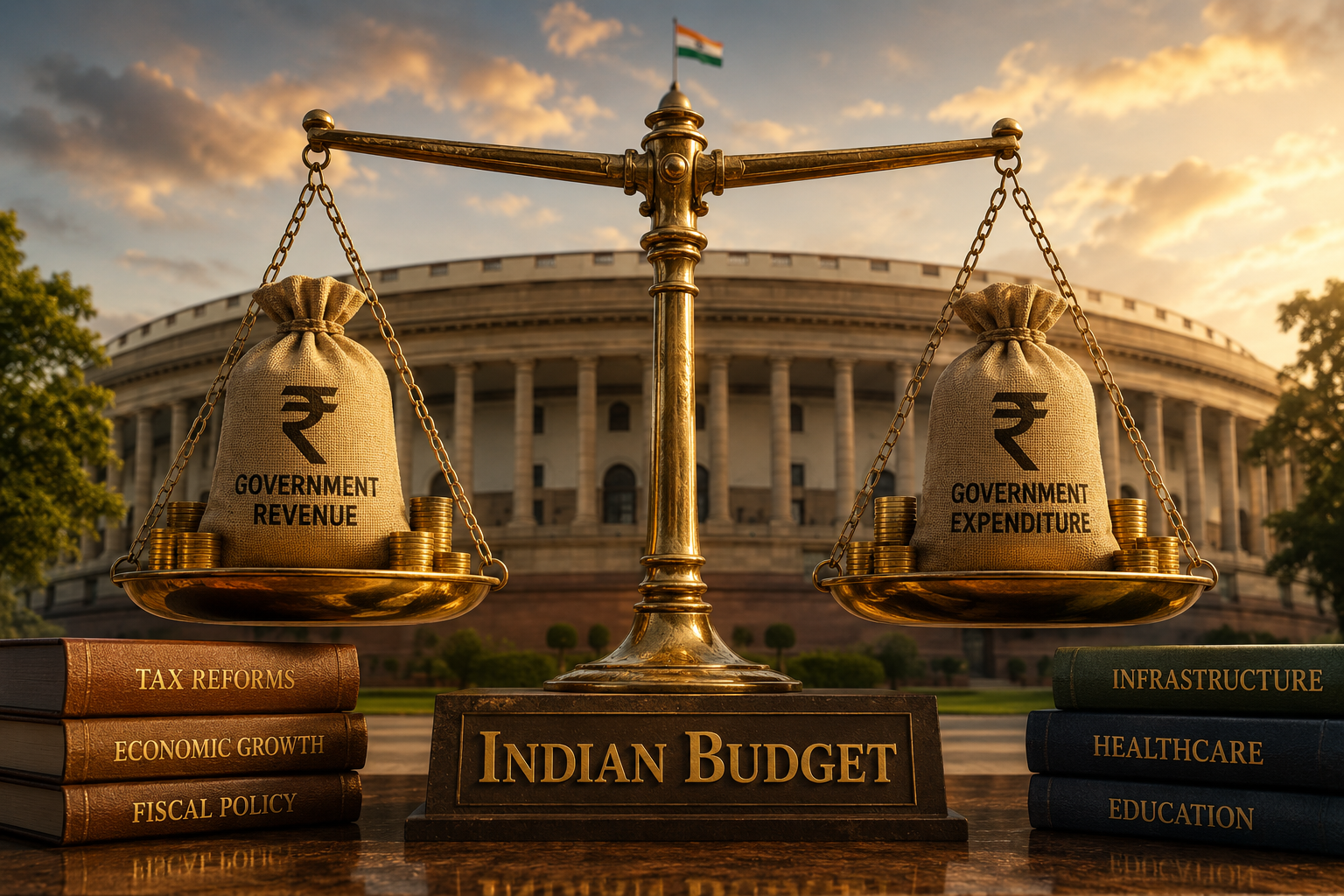
The Indian Public Finance System forms the backbone of the country's economic governance. It determines how the government raises revenue, allocates resources, finances development projects, manages deficits, and supports vulnerable sections of society through subsidies.
For competitive examinations such as UPSC, GPSC, SSC, Banking, Railways, State PSCs, and various government recruitment exams, understanding taxation, public expenditure, fiscal deficits, and subsidies is essential. These topics frequently appear in Prelims, Mains, interviews, and current affairs discussions.
This comprehensive guide explains the Indian Public Finance System in a simple, exam-oriented manner.
Public Finance refers to the management of government income, expenditure, borrowing, and debt.
It answers four key questions:
- How does the government earn money?
- How does the government spend money?
- What happens when expenditure exceeds revenue?
- How does the government support citizens through subsidies and welfare schemes?
Public finance is managed mainly by the Ministry of Finance and approved through Parliament.
Taxation is the primary source of government revenue.
A tax is a compulsory payment imposed by the government on individuals and businesses without direct consideration.
Direct taxes are paid directly to the government by the taxpayer.
Examples:
- Income Tax
- Corporate Tax
- Capital Gains Tax
- Securities Transaction Tax (STT)
- Cannot be shifted to another person
- Progressive in nature
- Helps reduce income inequality
If an individual earns ₹10 lakh annually, income tax is paid directly by that person.
Indirect taxes are collected from consumers through goods and services.
Examples:
- Goods and Services Tax (GST)
- Customs Duty
- Excise Duty (limited products)
- Burden can be transferred
- Paid indirectly through purchases
- Easier to collect
When purchasing a smartphone, GST is included in the final price.
GST was introduced on 1 July 2017 to create "One Nation, One Tax."
It replaced multiple indirect taxes and simplified the tax structure.
GST RateApplicable Goods and Services0%Essential goods5%Daily-use items12%Processed products18%Most goods and services28%Luxury and sin goods
- Removes tax cascading
- Simplifies taxation
- Enhances transparency
- Boosts ease of doing business
The GST Council is chaired by the Union Finance Minister and determines GST rates and policies.
Public expenditure refers to government spending for economic development and public welfare.
- Roads
- Railways
- Airports
- Ports
- Education
- Healthcare
- Nutrition programs
- Military modernization
- Border security
- Irrigation
- Crop insurance
- Farmer welfare schemes
- PM-KISAN
- MGNREGA
- Food Security Programs
Recurring expenses that do not create assets.
Examples:
- Salaries
- Subsidies
- Pension payments
- Interest payments
- Short-term benefits
- No asset creation
Spending that creates long-term assets.
Examples:
- Highways
- Dams
- Railway corridors
- Defense equipment
- Asset creation
- Long-term economic growth
Exam Tip:Capital expenditure is generally considered more productive for economic development.
Fiscal Deficit occurs when government expenditure exceeds government revenue excluding borrowings.
Fiscal Deficit = Total Expenditure – Total Revenue Receipts
- Increased government spending
- Lower tax collections
- Economic slowdown
- Emergency expenditures
- Promotes economic growth during downturns
- Generates employment
- Supports infrastructure development
- Inflationary pressure
- Increased government debt
- Higher interest burden
Revenue Deficit occurs when revenue expenditure exceeds revenue receipts.
Revenue Deficit = Revenue Expenditure – Revenue Receipts
Government is borrowing even for day-to-day expenses.
This is generally considered undesirable.
Primary Deficit measures fiscal deficit excluding interest payments.
Primary Deficit = Fiscal Deficit – Interest Payments
Shows the current year's borrowing requirement without past debt obligations.
Public debt refers to money borrowed by the government.
- Government Securities
- Treasury Bills
- Bonds
- World Bank loans
- Multilateral institutions
- Foreign governments
A subsidy is financial assistance provided by the government to reduce costs for citizens.
Subsidies help improve affordability and social welfare.
Provided through the Public Distribution System (PDS).
Benefits:
- Affordable food grains
- Food security
Supports farmers by reducing fertilizer costs.
Benefits:
- Higher agricultural productivity
- Lower farming expenses
Provided occasionally for LPG and essential fuels.
Benefits:
- Consumer protection
- Inflation control
Government pays part of the interest burden.
Examples:
- Education loans
- Housing loans
- Reduces poverty
- Improves food security
- Supports agriculture
- Encourages economic inclusion
- Fiscal burden
- Leakages and corruption
- Market distortions
- Inefficient targeting
The Union Budget is the annual financial statement of the Government of India.
Presented under Article 112 of the Constitution.
It includes:
- Revenue estimates
- Expenditure plans
- Fiscal deficit targets
- Tax proposals
- Economic outlook
ArticleSubjectArticle 112Union BudgetArticle 265TaxationArticle 266Consolidated FundArticle 267Contingency FundArticle 280Finance Commission
Fiscal deficit is the excess of total government expenditure over total revenue receipts excluding borrowings.
GST is a destination-based indirect tax introduced in India on 1 July 2017.
Revenue deficit occurs when revenue expenditure exceeds revenue receipts.
Public expenditure is government spending for administration, development, welfare, and infrastructure.
A subsidy is financial assistance provided by the government to support consumers or producers.
The Indian Public Finance System plays a crucial role in economic growth, welfare delivery, and fiscal stability. Taxation generates revenue, public expenditure drives development, fiscal deficits indicate borrowing needs, and subsidies support vulnerable populations.
For competitive examinations, candidates must understand the concepts of direct and indirect taxes, GST, public expenditure, fiscal deficit, revenue deficit, public debt, subsidies, and the Union Budget. Mastering these topics will significantly improve performance in economics, polity, and current affairs sections.
A strong understanding of public finance not only helps in examinations but also provides insight into how the Indian economy functions and grows.